Rental Comps vs. Fair Market Rents: When They Disagree
Published 2026-11-02
When you're underwriting a rental, you usually have two ways to estimate what a unit will bring in. You can pull actual rental comps — what similar units are leasing for right now — or you can look up the HUD Fair Market Rent (FMR) for the area. Most of the time these numbers land close enough that it doesn't matter which you lean on. But when they split by $200, $300, or more, you have a decision to make, and getting it wrong can turn a good-looking deal into a break-even grind.
What Each Number Actually Measures
Rental comps are market-driven. They reflect what tenants are paying today for comparable units in the same submarket — same bed/bath count, similar condition, similar neighborhood. Pulled correctly, comps are the closest thing you have to a live reading of demand.
Fair Market Rents are a government construct. HUD publishes them annually, usually set around the 40th percentile of gross rents in a metro area, and they're primarily used to set payment standards for Section 8 vouchers. The key words there are metro area and gross rent. FMRs are calculated at a wide geographic level — often an entire county or metro — and they fold utilities into the number because voucher programs care about total housing cost, not just the landlord's take.
Those two differences explain most disagreements you'll ever see.
Why They Disagree
Geography is the big one. A comp set is drawn from a few blocks or a single ZIP code. An FMR covers a sprawling metro where a luxury suburb and a distressed urban core get averaged into one figure. If your property sits in a strong pocket of a weak metro, comps will beat the FMR. If it sits in a soft pocket of a hot metro, the FMR may look generous compared to what tenants will actually pay.
Utilities inflate FMRs. Because FMR is a gross rent figure, it assumes the tenant pays for heat, electric, water, and so on out of that number. If your lease has the tenant paying utilities directly, your collectible rent is the FMR minus a utility allowance. People who forget this overstate income on paper.
Timing lags. FMRs are set once a year using data that's already a year or more old. In a fast-moving market, comps will run ahead of the FMR on the way up and above it on the way down. Comps are current; FMRs are a rearview mirror.
Condition and class. FMRs don't distinguish a renovated unit from a tired one. Comps do. A rehabbed property in a decent area routinely rents above FMR because the FMR is blended across everything from slum stock to clean units.
Which One to Trust
For market-rate underwriting, trust the comps — but only if you pulled them honestly. That means same submarket, same unit type, recent lease dates, and adjustments for condition. A lazy comp set is worse than an FMR. Run your comps through the analyzer so you're comparing apples to apples before you commit a rent number to your pro forma.
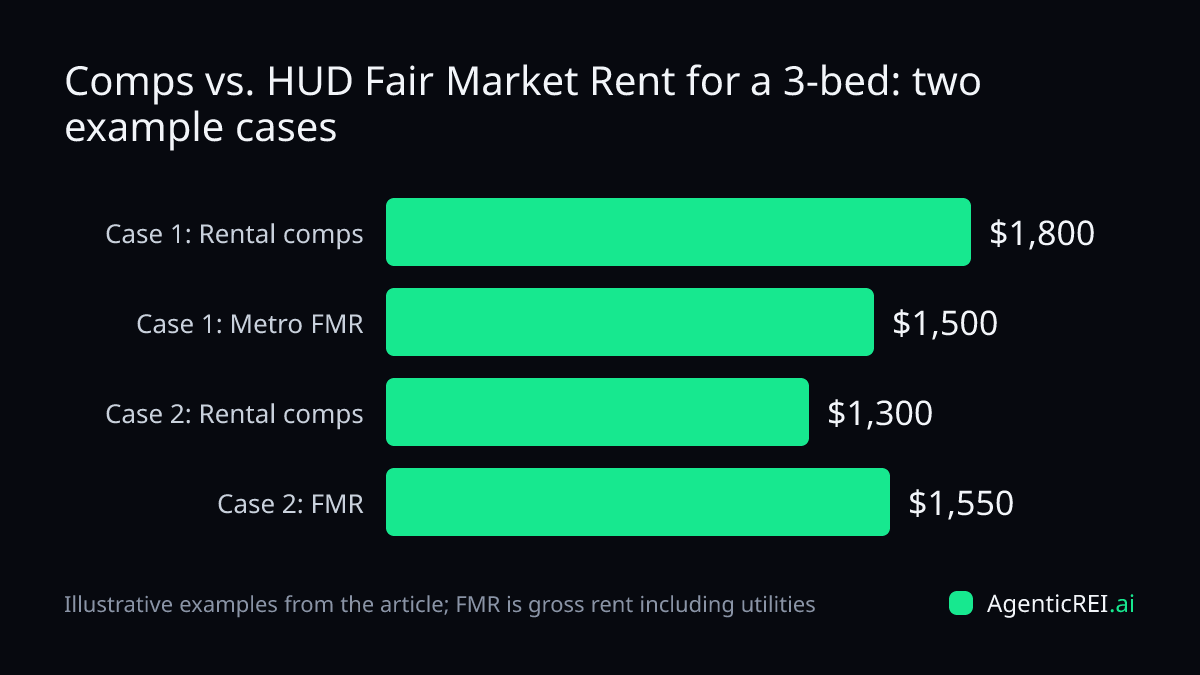
Use the FMR as a sanity check and a floor. Here's a clean illustrative case: your comps say a 3-bed in a revitalizing neighborhood should rent for $1,800. The metro FMR for a 3-bed is $1,500. That gap tells you two things — your pocket is outperforming the metro, and if you ever pivot to a Section 8 tenant, the voucher payment standard will likely cap you well below your market rent. Worth knowing before you buy.
Now flip it. Comps say $1,300, FMR says $1,550. That's a warning. Either your comps are from a weaker sub-area than the property, or the FMR is propped up by utilities and geography. When the FMR beats the comps, believe the comps and figure out why the gap exists.
The Section 8 Angle
If your strategy depends on voucher tenants, the FMR — specifically the local payment standard, which can run 90% to 110% of FMR — becomes the number that matters, because that's the ceiling on what the housing authority will pay. Here comps are the sanity check and the FMR drives the income. The two numbers swap roles entirely depending on your tenant base.
Build the Gap Into Your Model
When the numbers disagree, don't pick one and move on. Underwrite the conservative figure and note the upside. If comps say $1,800 and FMR says $1,500, run your returns at something like $1,650 so a soft comp set or a utility assumption doesn't blow up your cash flow. Stress-test both scenarios in the calculators, and check whether your submarket is trending with or against the broader metro using market reports.
Takeaway: pull your own comps at the ZIP-code level, subtract a utility allowance from any FMR before comparing, and underwrite the lower of the two — then treat the gap as information about your pocket, not noise to ignore.