Refi vs. HELOC: Getting Your BRRRR Capital Back Out
Published 2026-11-11
The Whole Point of BRRRR
The entire BRRRR strategy — Buy, Rehab, Rent, Refinance, Repeat — lives or dies on that fourth R. If you can't get your capital back out, you don't have a repeatable system, you just have a slow way to buy one rental. So the real question isn't whether to pull money out, it's how. The two tools most investors reach for are a cash-out refinance and a HELOC, and they behave very differently.
Let me walk through how each one actually works on a finished BRRRR, and when I'd pick one over the other.
Cash-Out Refinance: Replace the Whole Loan
A cash-out refi pays off whatever financing you used to buy and rehab, then replaces it with one new, bigger mortgage. You walk away with the difference in cash. Most lenders on an investment property will go up to about 75% of the new appraised value.
Here's an illustrative example. Say you bought a property for $120,000, put $30,000 into the rehab, and it now appraises for $200,000. Your all-in cash is $150,000. A refi at 75% loan-to-value gives you a new loan of $150,000. If you paid cash going in, that refi check hands you back essentially your entire $150,000 — fully recycled.
The tradeoffs:
- Fixed, long-term debt. You lock a rate for 30 years. In a higher-rate environment that rate stings, but it's predictable.
- Closing costs. Expect to pay points, appraisal, title, and lender fees — real money that eats into your pull-out.
- It resets your amortization. You're starting a fresh 30-year clock.
Run the new payment against your rents before you commit. A bigger loan at today's rates can flip a cash-flowing property into a break-even one. The analyzer will show you exactly where the new payment lands relative to rent.
HELOC: A Revolving Line Against Equity
A HELOC leaves your first mortgage alone and adds a second lien — a revolving credit line you can draw on, pay down, and draw again. On the same $200,000 property, a lender might let you borrow up to a combined 80% of value. If you had no first mortgage, that's a line up to about $160,000; if you have an existing loan, the line is the gap between that balance and the 80% ceiling.
What makes a HELOC attractive for BRRRR specifically is the revolving part. You pull the cash to buy your next deal, do the rehab, refinance that property into its own long-term loan, and pay the HELOC back down to zero — ready for the deal after that. It's a reusable bridge.
The tradeoffs:
- Variable rate. HELOCs typically float, so your cost can climb while you're carrying a balance.
- Interest-only draw periods feel cheap but can mask how much you're really leveraged.
- Harder to get on investment property. Many banks only do HELOCs on primary residences, so your options narrow and terms get worse on rentals.
The Numbers Side by Side
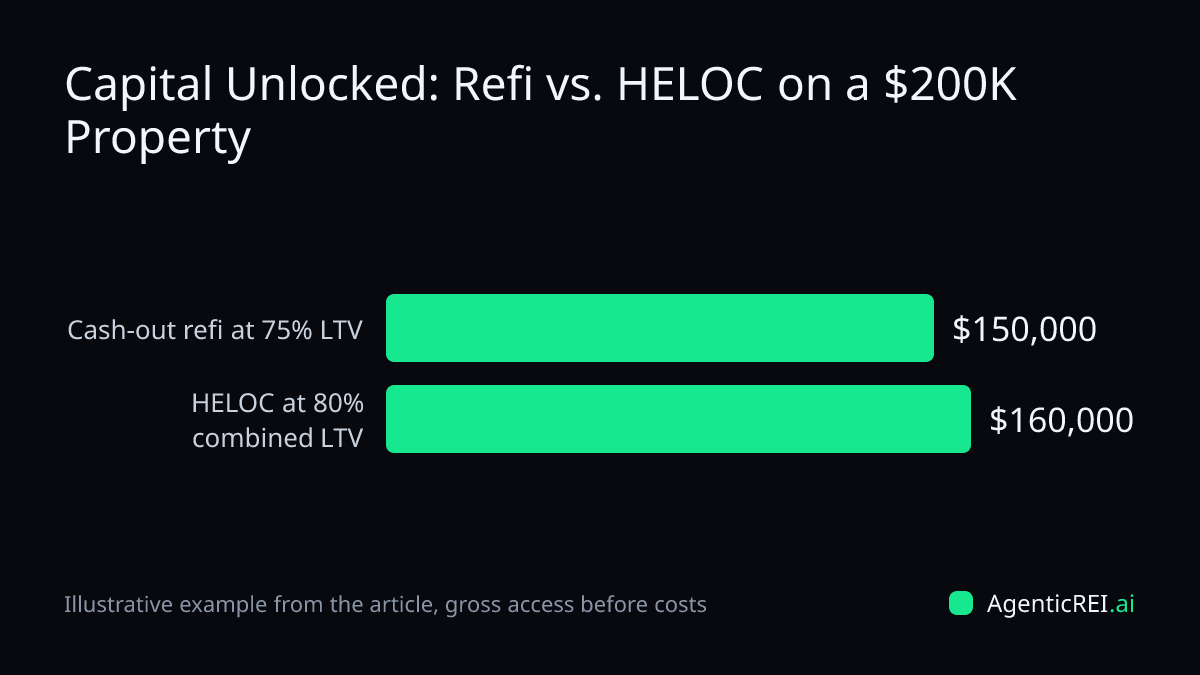
Using the same $200,000 property, here's roughly how much capital each tool unlocks before costs:
- Cash-out refi at 75% LTV: $150,000
- HELOC at 80% combined LTV (no existing first lien): $160,000
The HELOC looks like it gives you more, but that's gross access, not free money — you're paying variable interest on every dollar you leave outstanding. The refi converts a chunk to permanent debt you'll carry regardless.
How I Actually Decide
If the property cash flows well at the new fixed payment and I want to keep this one long-term, I refinance. Done. The capital is out, the debt is boring and predictable, and I move on.
If I want flexibility — to grab the next deal fast, recycle the money, and not commit to a permanent higher payment — the HELOC is the better bridge, as long as I have a clear plan to pay it back down. The danger is treating a HELOC like free equity and leaving it maxed across several deals. That's how a rate hike wrecks you.
Many experienced operators use both: a HELOC as the revolving war chest, then a refi on each stabilized property to term out the debt and reload the line. Check your target market reports for rents and values, and model both paths in the calculators before you pick.
Concrete takeaway: Before you touch either option, write down the new monthly payment and subtract it from your actual rent. If that number is negative at today's rates, you don't have a capital-recycling problem — you have a deal that doesn't cash flow, and no refi structure fixes that.