Self-Manage or Hire: The Real Math on Property Management
Published 2026-11-12
You are looking at a rental that pencils out. The rent covers the mortgage, taxes, and insurance with a little left over. Then you ask the question that trips up a lot of buyers: do I manage this myself, or hire someone?
The answer changes your cash flow, your free time, and sometimes whether the deal works at all. Let me walk you through the real math.
What property management actually costs
Most residential managers charge a monthly fee that is a percentage of collected rent. A common range is 8% to 12%. That is not the whole bill.
Here is what else shows up:
- A leasing fee when they place a new tenant, often half a month to a full month of rent.
- A renewal fee when a tenant stays, sometimes a few hundred dollars.
- A markup on maintenance, or a minimum charge per work order.
- A vacancy fee or setup fee, depending on the contract.
Read the agreement line by line. The headline percentage is the floor, not the ceiling.
The illustrative math
Say your rent is $2,000 a month. That is $24,000 a year.
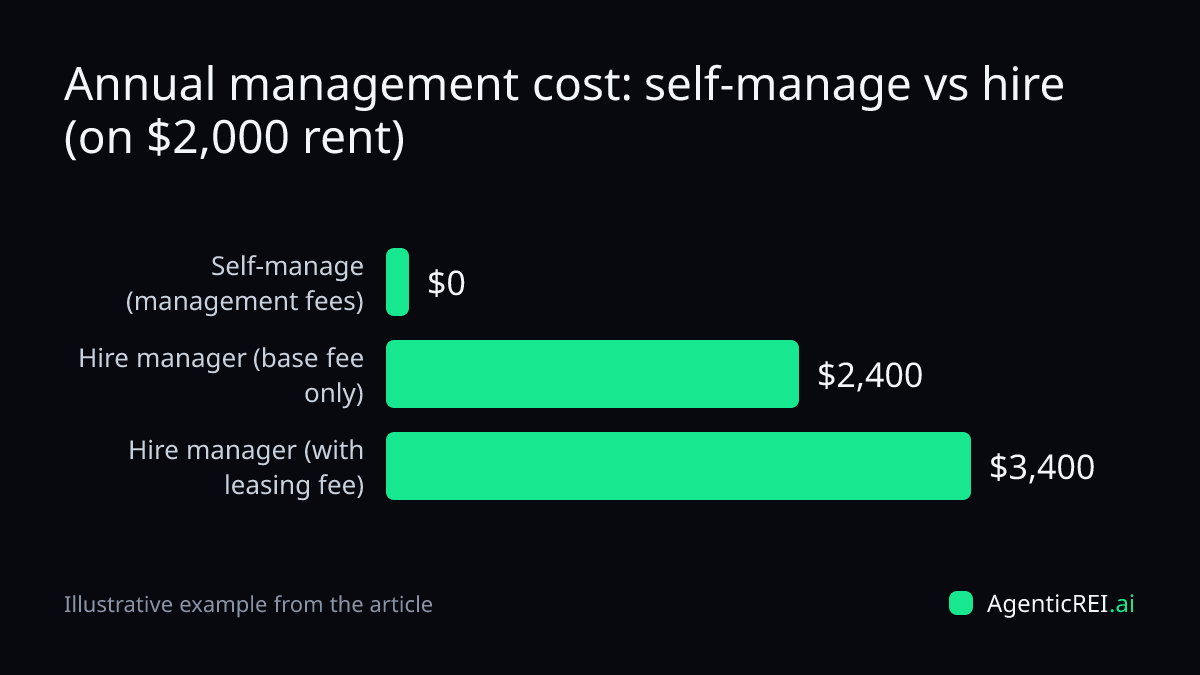
A manager at 10% takes $2,400 a year in base fees. Add a leasing fee of one month's rent when a tenant turns over. If you turn over every two years, that is $1,000 a year averaged out.
So your realistic management cost is closer to $3,400 a year on this example property, not the $2,400 the percentage alone suggests.
Now compare the two scenarios on the same $2,000 rent:
- Self-manage: $0 in management fees.
- Hire a manager: $3,400 a year in this example.
That $3,400 comes straight out of your cash flow. If the deal only throws off $4,800 a year before management, hiring a manager cuts your cash flow by more than two thirds.
That is the part people miss. The fee is small against rent but large against profit, because profit is what is left after everything else.
Why the fee hits profit so hard
Your expenses do not shrink because you hired help. The mortgage, taxes, insurance, and repairs are all still there.
The management fee is an extra line on top. And it comes out of the thin slice that was already your return.
This is exactly why running the numbers before you buy matters. A property that cash flows with self-management can flip to break-even or negative once you add a manager. If you ever plan to hand it off, you need to know that going in.
When self-managing makes sense
Self-managing can work when:
- The property is close enough to drive to.
- You have time to screen tenants and answer calls.
- You are comfortable handling or coordinating repairs.
- The deal is tight and the fee would eat your margin.
You are trading your time for that $3,400. For one or two local units, a lot of investors find that trade worth it in the early years.
When hiring is the smarter call
Hiring makes sense when:
- The property is far from where you live.
- You own enough units that managing is a real job.
- Your time is worth more than the fee, dollar for dollar.
- You simply do not want the tenant calls.
The key is to underwrite the deal with the manager's fee included from day one. If it only works when you do the work for free, it is not really a passive deal. It is a job you are not paying yourself for.
Build the fee into your walk-away price
Here is the move that protects you either way. Decide whether you will manage or hire before you make an offer, then price the deal around that choice.
If you will hire, bake the full management cost, fees and leasing and all, into your expenses. The price that makes the deal work with a manager is lower than the price that works if you do it yourself. That gap is real money.
This is where the analyzer earns its keep. Paste the address and it reads the listing, pulls a rent estimate, and runs the math with management as an expense, then gives you BUY, NEGOTIATE, or PASS plus the walk-away price. The first three analyses are free, no card. A real math engine does every calculation, so the fee is actually in the numbers, not left out to make the deal look better. You can also run it both ways by hand in the calculators.
Your takeaway: before you offer, run the same property twice, once self-managed and once with the full manager cost. If it only pencils when you work for free, lower your offer until it works with the fee in, or walk.