How to Read a Price Cut: What Seller Motivation Actually Looks Like in the Data
Published 2026-11-11
You are looking at a listing that dropped $15,000 last week. Your gut says motivated seller. Maybe. But a price cut by itself tells you almost nothing until you read the data around it.
Here is the thing: sellers cut prices for two very different reasons. One is a seller who needs out. The other is a listing that was overpriced from day one and is just drifting down to reality. You want to tell those apart before you write an offer.
A Price Cut Is a Story, Not a Headline
The drop is the last sentence. You need the whole paragraph.
Start with days on market (DOM), which is how long the home has been listed. A $15,000 cut after 7 days means the seller got nervous fast. The same cut after 90 days means the market already said no at the old number, and the cut is just catching up.
Then look at how many cuts there have been. One cut is a correction. Three small cuts over two months is a seller chasing the market down, always a step behind. That pattern often means more room below the current ask.
The Numbers That Separate Motivation From Mispricing
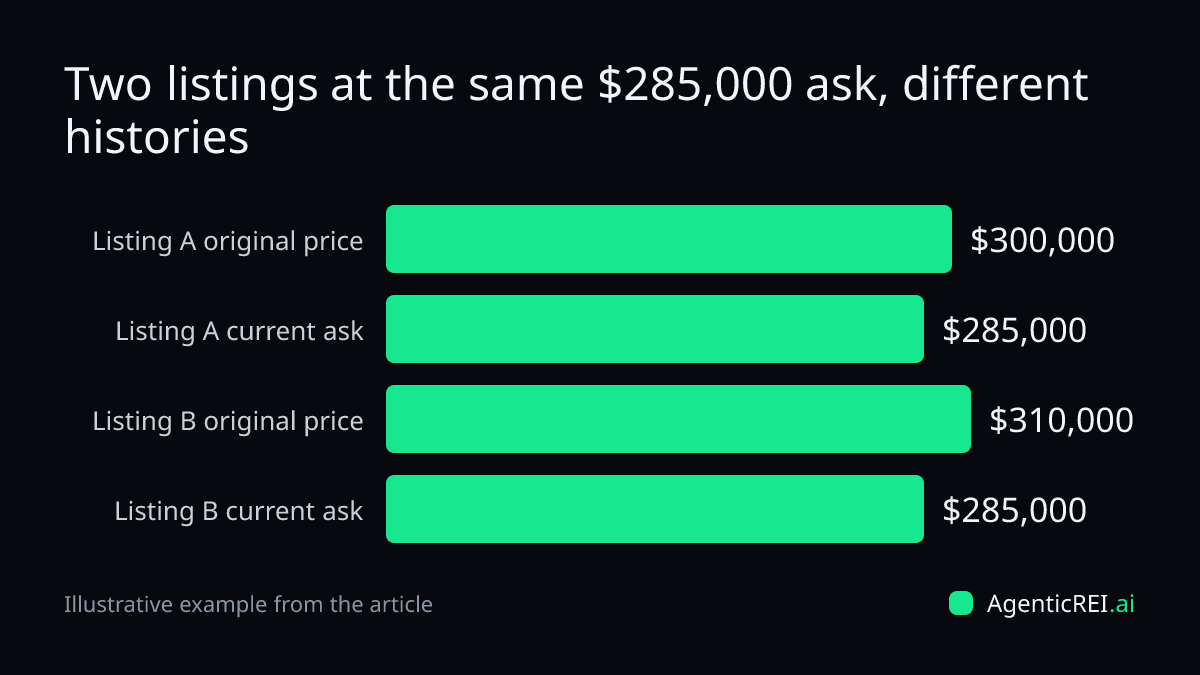
Here is an illustrative example of two listings, both asking $285,000 today.
Listing A: Listed at $300,000, one cut to $285,000 after 55 days, no offers. The original price was high for the block. This is mispricing correcting itself. The current number may still be above what the house is worth.
Listing B: Listed at $310,000, two cuts down to $285,000 in 40 days, and a note that the seller already bought elsewhere. That last detail is motivation. A seller carrying two mortgages feels every month.
Same current price. Very different negotiating room.
So watch these signals together:
- Cumulative days on market. Relistings reset the clock, so a "5 days" listing may really be 120 days across two tries.
- Total cut vs. original price. A 2% trim is a nudge. A 10% drop from the first ask says the original number was fiction or the seller is done.
- Cut timing. Fast cuts suggest urgency. Slow, repeated cuts suggest a stubborn seller slowly giving up.
- Listing language. "Motivated," "bring offers," "as-is," "estate sale," or "relocating" are context, not proof, but they add up.
Our market reports show what a standard rental actually pencils at in each metro, which helps you judge whether the new ask is even in the right range for the area.
Why the Signal Doesn't Set Your Offer
Here is the trap. A juicy price cut makes you anchor to the new number and feel like you are already winning. You are not. The seller's motivation tells you they might say yes to less. It does not tell you what "less" needs to be for the deal to work for you.
Those are two separate questions. One is about the seller. The other is about your math.
So flip the whole thing around. Instead of asking "is $285,000 a good deal?" ask "what price makes this a deal for me?" That walk-away number comes from the rent, the taxes, the insurance, the repairs, and your target return. It does not care how motivated the seller is.
This is where real calculation beats a gut feeling. The AI reads the listing, and a real math engine runs the numbers, so it cannot make up a cash flow figure to make you feel good. You can paste an address into the analyzer and get BUY / NEGOTIATE / PASS plus the exact price where the numbers work. The first 3 analyses are free, no credit card. If you want to run your own inputs by hand, the calculators do the same mechanics.
Use the Signal as Leverage, Not a Reason to Buy
Once you know your walk-away price, a price cut becomes a tool. If your number is $262,000 and the seller just cut to $285,000 after 60 days with two mortgages, you have a reason to open at your number and a story to back it up.
If your number is $262,000 and the house is a fresh listing with zero cuts and a line of showings, the motivation is not there yet. That is a PASS today, and a PASS is useful information, not a failure. You can revisit in 30 days.
The takeaway: before you let a price cut excite you, write down the one price at which this specific property pays you what you need, then negotiate toward that number no matter how the ask moves.