Out-of-State Investing: Underwriting a Market You Cannot Drive
Published 2026-10-26
Why Out-of-State Even Comes Up
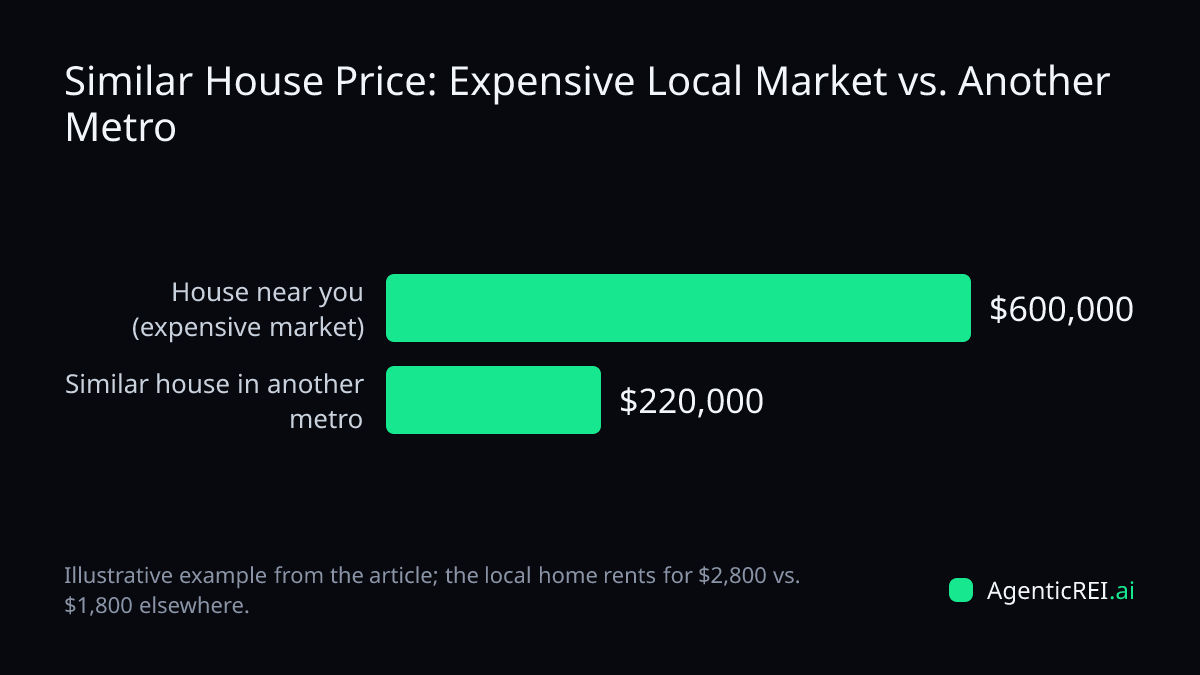
Most people don't choose out-of-state investing because it sounds fun. They choose it because the math in their backyard stopped working. If a house near you costs $600,000 and rents for $2,800, the rent-to-price ratio is broken before you start. Meanwhile a similar house in another metro might cost $220,000 and rent for $1,800. The spread is real, and it's why people with expensive-coast incomes end up buying in the Midwest and Southeast.
The catch is that distance removes your cheapest diligence tool: your own eyes. You can't drive the block at 9pm on a Friday. You can't tell that the "up-and-coming" area is one street deep. So you have to replace intuition with process.
You Are Underwriting Two Things, Not One
When you invest locally, you're really underwriting one thing: the deal. Out of state, you're underwriting the deal and the team that will run it for you. The second one matters more, because a mediocre deal with a sharp property manager beats a great deal run by someone who doesn't return calls.
So split your work accordingly. Spend real time vetting the operator layer before you fall in love with a specific address.
- Property manager — the single most important hire. Ask what percentage of their doors are owned by out-of-state investors like you, how they handle maintenance approvals, and what their average days-on-market is for turns.
- Agent or sourcing channel — someone who sends you deals, not someone who just opens doors.
- Boots on the ground — an inspector and a contractor you can trust to tell you the truth about a property you'll never see.
If you can't assemble that team, you don't have a market yet — you have a listing.
Reading a Market From a Desk
You're trying to answer three questions without being there: Will it rent? Will it hold value? Will it be a headache?
Start broad. Is the metro's population and employment base growing, flat, or shrinking? You don't need a forecast — you need a direction. A place that's slowly adding jobs and people forgives a lot of mistakes. A place quietly losing both punishes every one of them. Our market reports are built to let you compare metros on that kind of fundamental footing before you ever look at a single house.
Then go narrow. Rent and value live at the neighborhood and even the block level. Pull comparable rentals that are actually rented right now, not aspirational listings. Look at how long rentals sit before leasing. Check the spread between asking rents and what seems to actually close.
Replacing the Drive-By
You still need the street-level read, so recreate it with tools and people.
- Street view and aerials — walk the block virtually, then walk the surrounding six blocks. Look for deferred maintenance on neighbors, boarded windows, and whether cars in driveways look lived-with or abandoned.
- A paid local inspection — never skip this, and never rely on the seller's.
- A video walkthrough from your own person — your PM or contractor on a live call pointing the camera where you say, not a polished listing video.
- School and crime context — not as moral judgments but as rent-stability signals. Tenant turnover is expensive.
Pad Your Numbers for Blind Spots
The thing you can't see usually costs money. So underwrite more conservatively than you would at home. Because you're not there to catch small problems early, assume higher maintenance and higher vacancy than a local would.
A simple illustrative frame: if a local investor budgets 5% of rent for maintenance and 5% for vacancy, consider running 8% and 8% on a property you can't babysit. On $1,500 rent, that's roughly an extra $90 a month set aside — real money, but it's the price of not being able to tighten a leaky valve yourself before it becomes a ceiling.
Also build in a management fee you'll actually pay (often 8–10% of collected rent) plus leasing fees. Self-managing from 1,200 miles away is a fantasy for all but a handful of people. Run every scenario through the analyzer with those padded assumptions baked in, and lean on the calculators to pressure-test what happens if vacancy runs long or a turn costs double.
The Concrete Takeaway
Before you make an offer in a market you can't drive, have three specific people lined up by name: a property manager who manages for out-of-state owners, an independent inspector, and a contractor who'll give you a real repair number. If you can't fill those three slots, you're not ready to buy there — you're ready to keep researching. The team comes before the deal, every time.