Is the 1% Rule Dead? What the Math Says Now
Published 2026-10-15
Where the 1% Rule Came From
The 1% rule is a back-of-the-napkin screen: monthly rent should equal at least 1% of the purchase price. Buy a house for $200,000, collect $2,000 a month, and you clear the bar. It was never a law of physics. It was a shortcut that happened to approximate a cash-flowing deal during a specific era — one with cheaper money and lower price-to-rent ratios than we have today.
The reason it worked is that 1% of price in rent, after you back out taxes, insurance, maintenance, vacancy, and a mortgage at the rates common in the 2010s, usually left a few hundred dollars of monthly cash flow. The rule was a proxy for the real question: does the rent cover the costs with margin to spare?
Why the Math Broke
The rule assumed a stable relationship between rent and the costs of owning. Two of those costs have moved hard.
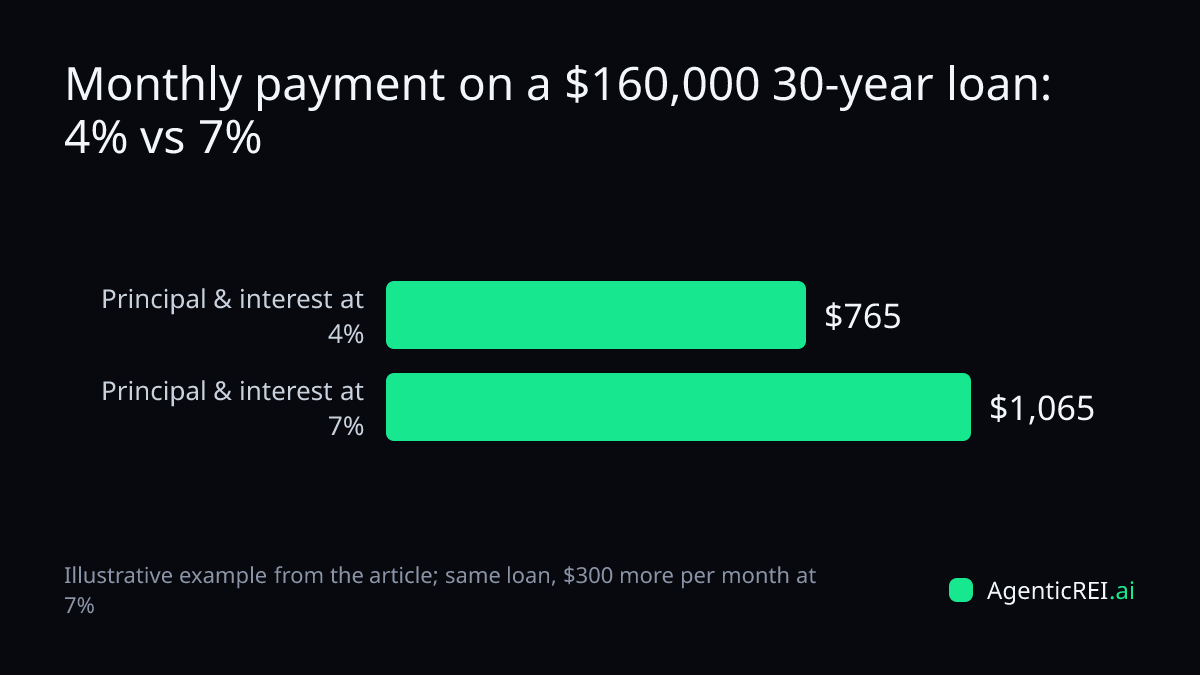
First, financing. When a 30-year loan carried a 4% rate, the monthly principal and interest on a $160,000 loan ran roughly $765. At 7%, that same loan costs about $1,065 a month. That's $300 of additional monthly cost on the exact same property — gone straight off the top of your cash flow. The rent didn't change, but the math underneath the rule did.
Second, prices rose faster than rents in a lot of markets. When a property that used to sell for $200,000 now sells for $320,000 but rent only climbed from $2,000 to $2,400, the rent-to-price ratio drops from 1% to 0.75%. The deal that cleared the bar a few years ago fails it now — not because it's a worse rental, but because the denominator grew.
Stack those two together and a property hitting exactly 1% today often cash flows poorly or negatively, where the same ratio five years ago threw off real money.
What the Rule Was Really Measuring
Here's the useful way to think about it. The 1% rule is a disguised debt-service-coverage check with assumptions baked in. It only tells you something true when those assumptions hold. Change the interest rate, the tax burden, or the insurance cost, and the rule quietly stops meaning what you think it means.
An illustrative example. Take a $300,000 property renting for $3,000 — a clean 1% deal.
- Rent: $3,000
- Taxes, insurance, maintenance, vacancy reserve: roughly $1,100
- Loan of $240,000 at 7%: about $1,600
That leaves around $300 a month before any capital expense surprises. Not terrible, but thin. Now run the same property in a high-tax, high-insurance market where those operating costs are $1,500 instead of $1,100. You're at negative cash flow on a deal that passed the rule with flying colors. Same 1%, completely different outcome.
That's the core problem: a single ratio can't see your tax rate, your insurance quote, or your actual financing. Those are exactly the variables that decide whether a deal works now.
A Better Screen
I don't throw the 1% rule out — I use it as a first-glance filter to decide what's worth underwriting, nothing more. If a property is sitting at 0.5%, I don't need a spreadsheet to pass on it. If it's at 1% or better, it earns a real look.
The real look means running actual numbers: your rate quote, the actual tax bill, a current insurance estimate, and honest reserves for vacancy and capital expenditures. Then look at cash-on-cash return and debt-service coverage, which respond to the inputs that actually vary by market and by deal. A 0.9% property with low taxes and an assumable loan can beat a 1.1% property buried in insurance costs. The ratio won't tell you that. The full math will.
That's the whole reason to run deals through the analyzer instead of trusting a single number, and why the calculators ask for taxes, insurance, and your real rate rather than assuming them. If you're deciding where to even look, pull market reports to compare rent-to-price ratios across metros before you commit to underwriting a single property.
So Is It Dead?
The rule isn't dead — it's just demoted. It was always a proxy, and the thing it was a proxy for (positive cash flow after real costs) still matters exactly as much as it ever did. What's changed is that today's rates and prices have broken the shortcut's reliability, so you can't lean on it the way investors did a decade ago.
Your concrete takeaway: use the 1% rule only to decide which properties deserve a full underwrite, then make every buy decision on cash-on-cash return and DSCR calculated from your actual rate, tax, and insurance numbers — never on the ratio alone.