The Insurance Shock: Underwriting Premiums That Doubled
Published 2026-10-22
The Line Item That Quietly Broke Deals
For years, insurance was the boring line in a pro forma. You plugged in a number, maybe $800 to $1,200 a year on a single-family rental, and moved on. That habit is now costing people money. Owners across large swaths of the country are opening renewal notices and finding their premium didn't creep up 5 percent — it jumped 40, 60, or in some cases more than 100 percent. A property that penciled at a 7 cap suddenly doesn't, and nobody touched the rent.
If you underwrote a deal in the last couple of years using last year's premium, you may be carrying a worse asset than you think. And if you're buying now, the old assumptions will get you hurt.
Why Premiums Are Moving So Hard
You don't need to track carrier earnings to understand the mechanics. Insurers price off two things: the cost to rebuild your property and the probability they'll have to pay. Both went the wrong direction at the same time.
Construction costs rose, so the replacement cost on your policy went up even if the house is identical. A home insured to rebuild for $200,000 three years ago might carry a $300,000 replacement figure now, and premium scales with that number. On top of that, carriers reprice risk after bad loss years. When they pay out more than expected, they either raise rates or leave the market entirely. When carriers leave, the ones remaining have less competition and more pricing power. That's the squeeze.
It hits hardest in coastal, wildfire, hail, and flood-exposed areas, but it's not only those. Even low-risk markets feel the pull because reinsurance — the insurance that insurers buy — got more expensive everywhere.
How to Underwrite Insurance Now
Stop using a flat dollar figure you remember from an old deal. Here's the discipline I use before committing to anything.
Get a real quote before you close, not after. Call an independent agent with the actual address, year built, roof age, and construction type. A quote takes a day. Assuming a number can cost you the whole margin.
Underwrite to the renewal, not the first-year teaser. Some policies are priced low to win the account, then reset. Ask the agent directly what a realistic renewal looks like. Build that higher number into your model in the analyzer so your cash flow isn't a one-year illusion.
Pad your estimate when you can't get a quote. For a quick screen, I'll assume insurance runs meaningfully higher than the listing agent claims — often 30 to 50 percent more in exposed markets — and see if the deal still works. If it only works at the optimistic number, it doesn't work.
Roof age is a gating item. Many carriers won't write, or will heavily surcharge, a roof over 15 to 20 years old. A deal with an aging roof carries a hidden double cost: a near-term capex replacement and higher premiums until you do it.
An Illustrative Example
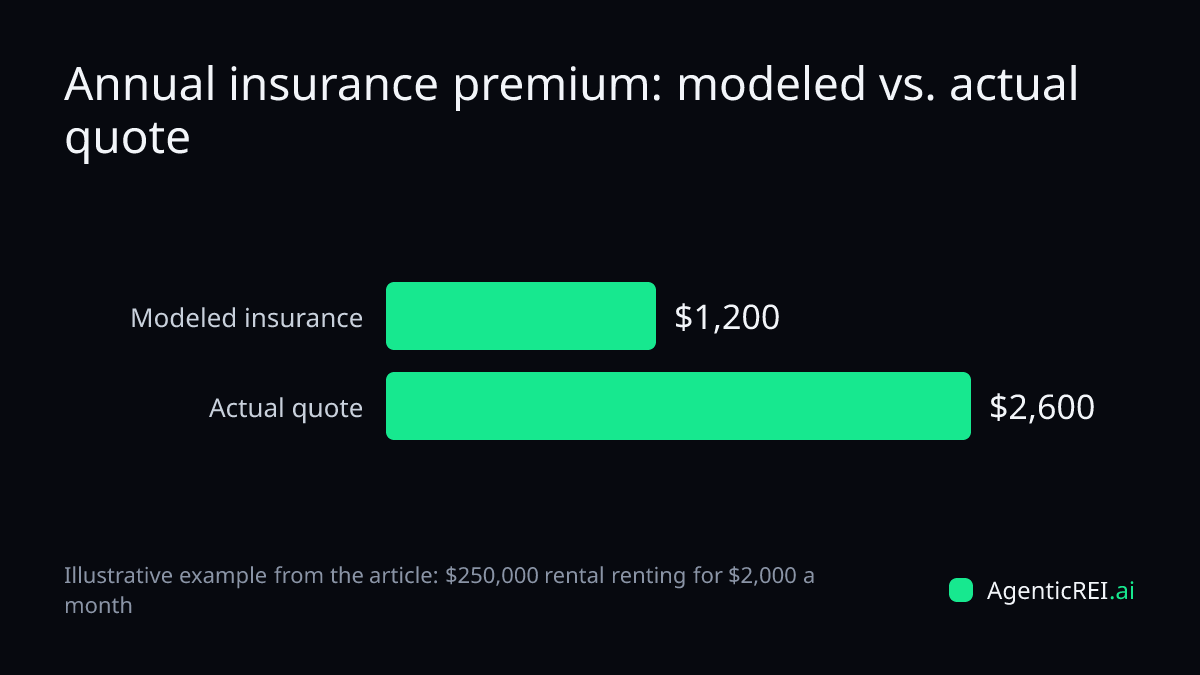
Say you're buying a $250,000 rental renting for $2,000 a month. You modeled insurance at $1,200 a year. The real quote comes back at $2,600 — not unusual in a hail or coastal zone right now.
That extra $1,400 a year is about $117 a month straight off your cash flow. If you expected $250 a month in cash flow, you just lost nearly half of it on one line item. Your cash-on-cash return drops accordingly, and the deal you thought was a clear yes becomes a maybe. Run both numbers through the calculators and the gap is obvious on paper — which is exactly where you want to find it, not after closing.
What You Can Actually Do About It
You can't fix the reinsurance market, but you have levers.
Raise your deductible if you have reserves to self-insure the small stuff — a higher deductible can meaningfully cut premium. Shop every renewal through an independent agent rather than auto-renewing; loyalty is not rewarded here. Bundle policies across a portfolio if a carrier will package them. Address roof and electrical issues that trigger surcharges. And factor regional insurance trends into where you buy in the first place — some market reports look great on rent-to-price until you layer in what it costs to keep the roof covered.
Most importantly, treat insurance as a variable expense that grows, not a fixed one. Model annual increases into your long-term hold the same way you model rent growth and taxes.
Concrete takeaway: Before your next offer, get one real insurance quote on the actual address and underwrite the deal at that number plus a 20 percent cushion. If it still cash flows, proceed. If it only works at the old assumption, walk.