House Hacking: Underwriting the Unit You Live In
Published 2026-11-11
The Mistake Most House Hackers Make
House hacking is the cleanest on-ramp into real estate I know of. You buy a two-to-four unit property with a low-down-payment owner-occupant loan, live in one unit, and rent the others. The tenants chip away at your mortgage. Done right, you live cheap and build equity on someone else's dime.
The mistake isn't buying one. It's underwriting one. New investors run the numbers as if the property were a pure rental, see the other units covering most of the payment, and declare victory. Then they move out in two years, the unit they lived in goes vacant until it's leased, and the "great cash-flowing deal" turns out to be a break-even property with a thin margin.
The fix is to underwrite the house hack two ways at once: how it performs while you live there, and how it performs the day you leave.
Count the Unit You Live In — Even Though You Don't Pay Yourself
The unit you occupy has a market rent whether you collect it or not. Ignoring it is the single biggest distortion in house-hack math.
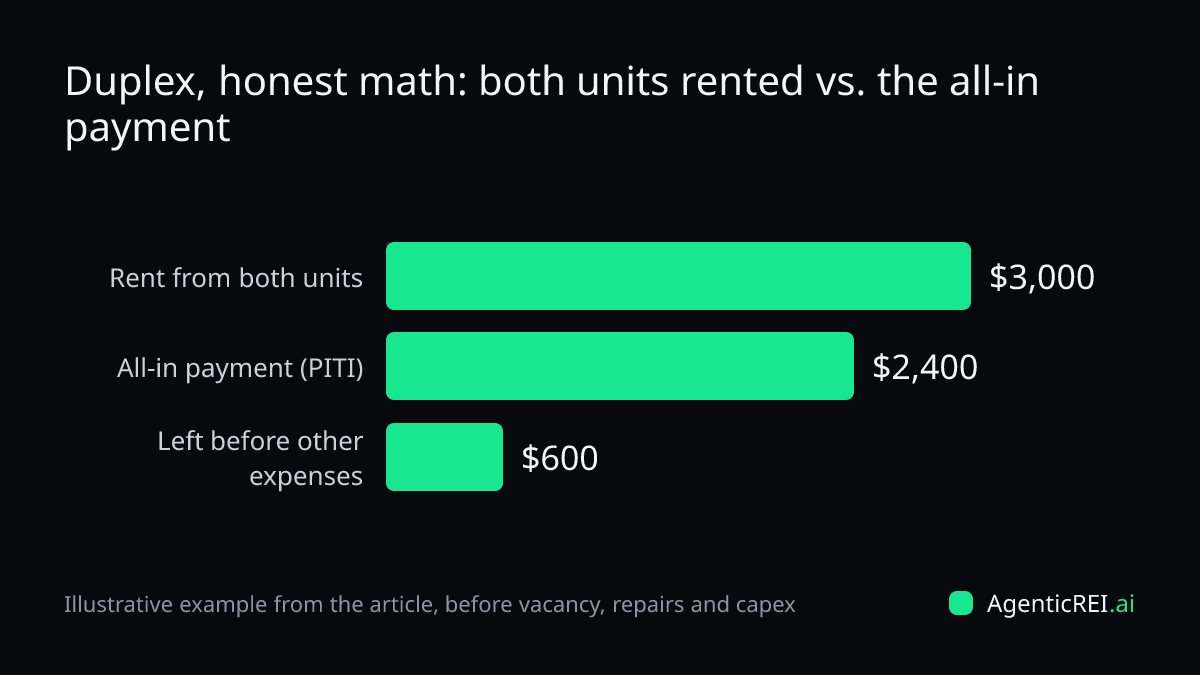
Say you buy a duplex. Each side rents for $1,500. Your all-in payment — principal, interest, taxes, insurance — is $2,400 a month. If you only count the $1,500 from the rented side, you feel like you're paying $900 to live there, which sounds fantastic.
But the honest underwriting treats the property as a $3,000-a-month gross rental that happens to have you as a non-paying tenant in one unit. On a true rental basis, $3,000 in rent against $2,400 in payment leaves $600 before you ever account for vacancy, repairs, and capital expenses. That reframing matters because it tells you what the asset actually does, not what your personal housing budget feels like.
I run both numbers through the analyzer on every house hack: the live-in cash flow and the moved-out cash flow. If only the first one works, it's a housing decision, not an investment.
The Live-In View vs. the Exit View
Here's the comparison that keeps people honest. Using the duplex above, and setting aside a reasonable 20% of gross rent for vacancy, maintenance, and reserves:
- While you live there: you collect $1,500, pay $2,400, and absorb the gap. Your out-of-pocket housing cost is roughly $900 a month — but remember you're also setting aside reserves on the one unit you rent.
- After you move out: you collect $3,000, pay $2,400, and set aside about $600 in operating reserves, leaving around $0 in true monthly cash flow.
That's the uncomfortable truth a lot of house hacks hide. The property that saves you $900 a month in rent while you live there may barely break even as a standalone rental. That doesn't make it a bad deal — saving $900 a month is real money, and the loan is paying down regardless. But you need to know which lever is doing the work.
Underwrite for the Loan You Have, Not the One You Want
Owner-occupant financing is the whole advantage. Lower down payment, better rate, and you only have to occupy for twelve months in most programs. Build that reality into the model:
- Assume you move out after the occupancy requirement, and underwrite the exit view at that point.
- Don't forget that your low down payment means a bigger loan and a bigger payment than an investor putting 25% down would carry.
- If there's mortgage insurance, keep it in the payment until you'd realistically remove it.
Run a few purchase prices and rent assumptions through the calculators before you fall in love with a specific building. Pull comps for the unit mix you're targeting — small multifamily rents behave differently than single-family, and local market reports will tell you whether $1,500 a side is realistic or wishful.
What Actually Makes a House Hack Work
The deals that hold up share a pattern: the rented units cover most or all of the payment while you live there, AND the property at least washes its face as a full rental after you leave. When both are true, you've bought cheap housing today and a self-sustaining asset tomorrow.
When only the live-in number works, you can still do it — just name it correctly. It's a lifestyle subsidy with equity upside, not a cash-flow machine.
The takeaway: before you make an offer, write down two monthly cash-flow numbers — live-in and moved-out — side by side. If you can't say both out loud, you don't understand the deal yet.