Why You Should Underwrite the Exit Before the Entry
Published 2026-11-19
Start at the end
You are staring at a listing you like. The rent looks fine, the price feels close, and your instinct is to run the numbers on getting in.
Stop. Underwrite how you get out first.
The exit is where most of your return actually shows up or disappears. If you do not know how you leave a property, you do not really know what you can pay to enter it.
What "the exit" means
Every property has an exit, whether you plan for one or not.
For a buy-and-hold rental, the exit is a future sale or a refinance that pulls your cash back out. For a flip, the exit is the resale at ARV (after-repair value, what it sells for once fixed). For a BRRRR (buy, rehab, rent, refinance, repeat), the exit is the refinance that determines how much of your cash stays trapped.
The entry price is just the cost of admission. The exit is the payoff.
Why the exit sets your entry price
Here is the mechanics. Your maximum entry price is whatever lets the exit still work.
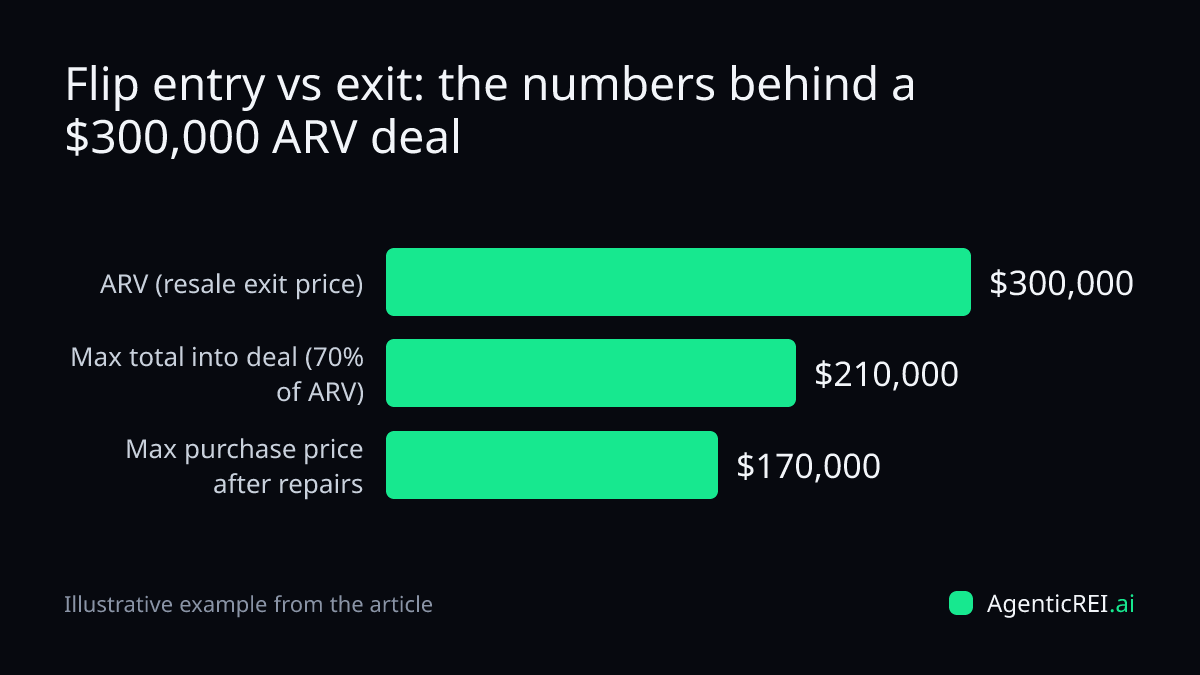
Take a flip. Say comparable sales tell you the ARV is $300,000. A common rule is to keep your total into the deal around 70% of ARV minus repairs. That is $210,000 total. If repairs run $40,000, your maximum purchase price is $170,000.
That $170,000 is not a guess. It is dictated backward from the exit. Pay $185,000 and the same renovation now eats your margin, even though nothing about the house changed.
The exit told you the entry. Not the other way around.
The refinance exit is where BRRRR lives or dies
For a hold, the quiet exit is the refinance. This is where people get surprised.
Say you buy and rehab to an after-repair value of $200,000. Your lender refinances at 75% of that value, so the new loan is $150,000. If you are all-in for $160,000, you leave $10,000 stuck in the deal. If you are all-in for $145,000, you pull your cash back out and move on.
Same property. The difference is entirely in what you paid to get in, measured against the exit the appraisal allows.
Underwrite that refinance before you ever sign the purchase contract. The calculators let you run one strategy by hand with your own numbers so you can see where the cash gets trapped.
The sale exit: do not bank on appreciation
For a long-term hold, the honest move is to underwrite the sale with conservative assumptions.
Assume the property sells for roughly what you paid, adjusted only for the value you forced through improvements. Then subtract selling costs. A reasonable placeholder for agent commission plus closing is around 8% of the sale price.
If the deal only works because you assumed prices climb 5% a year, that is not a deal. That is a bet on the market, and the market does not owe you anything.
Run the entry only after the exit survives
Once the exit math holds, now you underwrite the entry: purchase price, rehab, financing, and monthly cash flow.
The point of doing it in this order is that the exit gives you a ceiling. The entry math tells you whether you clear your return at or below that ceiling. When the two meet, you have your walk-away price, the highest number you can pay and still have the deal work.
That walk-away price is the whole game. It is the difference between "is this a deal?" and "what price makes this a deal?"
This is also where the analyzer earns its keep. Paste an address and it reads the listing, pulls records and a rent estimate, runs six strategies including the exit math, and hands you BUY, NEGOTIATE, or PASS plus the walk-away price. A real math engine does every calculation, so it will not flatter a bad deal. The first three analyses are free, no card.
A PASS from the exit is good news
If the exit math says the numbers only work below a price the seller will never accept, that is a PASS. That is not a failure. That is you keeping your capital for the next one.
The deals that wreck people are the ones where the entry looked fine and nobody checked the way out.
Your takeaway
Before you make an offer on the property in front of you, write down one number: the price it sells or refinances for at your exit, minus selling or refinance costs, minus your required margin. Whatever that leaves is your maximum entry price. Do not offer a dollar over it.