Cash-on-Cash vs. Cap Rate: Which Number Actually Decides
Published 2026-10-12
New investors treat cap rate and cash-on-cash return like they're interchangeable. They aren't. One describes the property. The other describes your deal. Confuse them and you'll either overpay for a "good" cap rate or talk yourself out of a solid acquisition because the cash flow looks thin on paper. Let's separate them cleanly.
What Cap Rate Actually Measures
Cap rate is net operating income divided by price. NOI is your gross income minus operating expenses — taxes, insurance, management, maintenance, vacancy — but before debt service. That last part matters. Cap rate ignores your loan entirely.
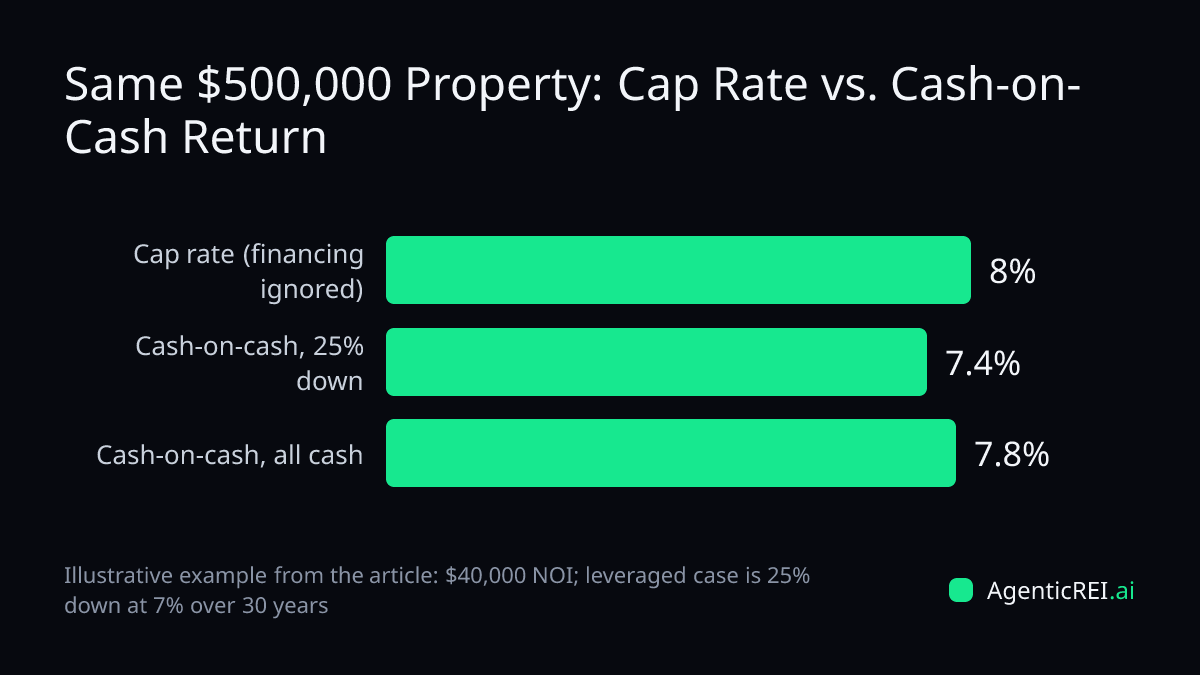
Say a property produces $40,000 in NOI and you buy it for $500,000. That's an 8% cap rate. It would be an 8% cap rate whether you pay all cash, put 20% down, or finance 90% of it. The financing doesn't exist in this number.
That's the whole point of cap rate: it's a way to compare properties on equal footing, stripped of how any particular buyer happens to fund the purchase. It answers "what does this asset yield on its own?" It's an unlevered return, and it's really a pricing tool more than a performance tool. When people say a market "trades at a 6 cap," they're describing what buyers are willing to pay per dollar of income.
What Cash-on-Cash Actually Measures
Cash-on-cash is annual pre-tax cash flow divided by the actual cash you put into the deal. This one cares deeply about your loan, because debt service comes out of the cash flow and the down payment is most of your cash in.
Take that same $500,000 property with $40,000 NOI. Put 25% down — $125,000 — plus say $10,000 in closing costs, so $135,000 of real cash in. Finance $375,000 at 7% over 30 years and your debt service runs roughly $30,000 a year. Cash flow after debt is about $10,000. On $135,000 in, that's roughly a 7.4% cash-on-cash return.
Change the financing and the number moves. Pay all cash and you keep the full $40,000 but on $510,000 invested — about 7.8% cash-on-cash, which now sits close to the cap rate because there's no leverage. Those are illustrative figures, but the mechanic is the one to internalize: cash-on-cash is your actual spendable return on your actual dollars, and leverage reshapes it.
Where Each One Misleads You
Cap rate misleads when you forget it says nothing about your returns as a leveraged buyer. A 5 cap in an expensive metro and a 9 cap in a rough secondary market can produce wildly different cash flow outcomes once you layer on a mortgage — especially when the loan rate is higher than the cap rate, at which point leverage actually drags your return down instead of lifting it. That's negative leverage, and plenty of buyers walk into it chasing "low cap rate = safe."
Cash-on-cash misleads in the other direction. It's a snapshot of year one. It ignores principal paydown, appreciation, and tax benefits — three of the four ways real estate actually builds wealth. A deal with a mediocre 6% cash-on-cash might be quietly throwing off another several points of return through amortization and rent growth you don't see in that single number. It also rewards aggressive financing, so a deal can look great on cash-on-cash while being dangerously thin on actual monthly buffer.
Which One Decides
Use cap rate to judge the price and compare properties. Use cash-on-cash to judge your deal and whether the cash flow justifies the capital. Neither one alone makes the call.
In practice I screen with cap rate — is this priced sanely for the market and the asset? — then underwrite the actual financing and look at cash-on-cash to confirm the deal pencils for me. If I'm holding long term, I'll also run a fuller return that includes principal paydown and projected appreciation, because cash-on-cash undersells buy-and-hold. If I'm chasing immediate cash flow or planning a shorter hold, cash-on-cash carries more weight.
The spread between the two tells its own story. When cap rate sits well above your loan rate, leverage is working for you and cash-on-cash should comfortably exceed the cap rate. When they're close or inverted, you're betting on appreciation and rent growth, not current income — know that going in. You can pressure-test all of this quickly with the analyzer or the calculators, and sanity-check cap rates against local pricing in the market reports.
Concrete takeaway: Before your next offer, calculate the cap rate and your loan's constant (annual debt service ÷ loan amount) side by side. If the cap rate is below that constant, leverage is working against you — either negotiate the price down or expect your cash-on-cash to come in under the cap rate, and decide if the appreciation story is worth it.